Friday, 19 October 2012

What do you do on a wet day in Oregon?


Oh dear, the rain has finally caught up with us. Friends had warned us but we have had great weather to date. We arrived in Seattle just after a storm that marked the end of an unprecedented 80 days without rain. True to form, when the rain sets in, we revert to the British habit of making the weather our main topic of conversation. To our surprise the local climate appears to be much the same as ours with wet summers, wet winters and wet everything else…..

Despite the weather the coast is still stunning

The Oregon coast still stuns us but we have upped our pace in an attempt to run down the coast to hopefully better weather and California.

Last night’s hotel was surprisingly better than we would have imagined. First impressions were those of a residential home in Mid Wales with a clientele to match. On the contrary, the bedrooms were comfortable, the restaurant was good and our rooms led straight out onto the attractive but wind blown beach. It all goes to show that either one should not trust first impressions or we are nearer residential home age than we think.

Yachats is an attractive little town based around a small river estuary. The Spanish and British including Sir Francis Drake visited this coast in the 16th Century. Captain Cook sailed here in March 1778 and saw a massive Headland shrouded in mist and named it Cape Perpetua in honour of and early Christian saint (St Perpetua). The headland has great views and trails that allow you to view this part of the Oregon coastline. We were sadly beaten back by the weather and St Perpetua will have to wait for another time.
Sir Francis Drake

Captain Cook

Further down the coast, we visited the largest sea cave in the world. This vast cave is a thousand feet in length and is accessed by an elevator from the roadside. It is renowned for the Sea Lions who live there most of the year. Unfortunately the little bit of the year that they don’t inhabit this extraordinary natural cavern coincided with our visit. Our guide told us the they had simply just “Gone fishing!”

Sea Lion Cave: The largest sea cave in the world. No Sea Lions!

Florence is a rather plain town built on the banks of the Siuslaw River. We had a snack in Mo’s restaurant overlooking the river and the Siuslaw Bridge. Better coffee than usual and shrimp, shrimp and more shrimp to eat. Oregon is known for its many bridges that cross the estuaries and rivers running into the Ocean. Many of these were designed by Code McCullough who decorated them with Art Deco and ancient Egyptian motifs. The Florence Bridge is one of the most attractive.

The Art Deco/Egyptian Bridge over the Siuslaw River at Florence

The beaches south of Florence are known for the vast network of sand-dunes that carry on for 50 miles. Some of them are the size of small hills and are covered by beautiful pine forests. These Oregon dunes were the inspiration for Frank Herbert’s ecological sci-fi saga Dune. We arrived at the sea’s edge in driving rain in one of the many state parks to find a large empty car park with a sign telling us that it was heavily congested. We clearly had missed a sudden exodus or we were just blind to something obvious.
Hooligans in the Dunes

50 miles of dunes

All along the coast we are reminded of the decline in the logging industry. Coos Bay is such a community. The port, once busy with logging ships from around the world is now quiet with deserted quays, rundown shops and the ubiquitous empty motels. This place has the same feel of industrial, social and personal decay that we see in the old post-industrial parts of the UK. What do areas such as this do when the only industry disappears? It must be impossible to stop the downward spiral of despair with the loss of work, young people and hope for the future.


The rain stops by the time we reach Bandon but the wind gathers strength. It’s getting more exciting as we skirt the local headland. Stacks rise majestically from the raging sea to be battered by the endless ferocious waves. We all feel that the weather now gives the landscape a more exciting and adventurous spirit. Added to this the periodic mournful sound of the foghorn competing with the howling scream of the wind. Jacqui who has just finished reading Daphne du Maurier’s “Birds” points out the menacing image of large numbers of seagulls gathering around us. I point out to her that they are just cold and fed up! Liz on the other hand is excited to see Cranberry Bogs being flooded prior to harvesting.

Windswept beaches at Bandon

Bandon Lighthouse

The gathering birds. Are they a risk?

Big weather!

Bandon's Face Rock

Another stop for a further snack! We must stop this indulgence.  Port Orford is still a working fishing port and it has a wonderful seafood cafĂ© amongst the fishing boats called “Griffs on the Dock”. Great seafood, its hard to avoid temptation when we should only be having tea. Liz had a chocolate cake as well!

Griff's on the Dock: Best fish and chips

The Three Bridges

Finaly we arrive in California; The Sunshine State”. Yet it carries on raining.

And yet it still rains!

Thursday, 18 October 2012

Our Oregon Trail


The King Columbia River

We crossed into Oregon over the great Columbia River after dark last night. It was not until morning that we realised the scale and majesty of this great river and the vast bridge that crosses it.  The bridge, finished in 1966 linked the Washington section of Route 101 to the remainder of the West Coast highway.

Crossing the great river

I remember that one of the first musicians that I listened to when I was a boy was Lonnie Donegan.  My brother is 7 years older and I used to listen to his records all the time. I always loved Donegan’s “The Grand Coulee Dam”. It was many years later when I learnt that the original song was written by one of the master songwriters of American folk music, Woody Guthrie. He described the majestic and grand Columbia River.  I always wanted to see it and it lived up to its reputation as it passes into the Pacific Ocean  at Astoria.

Master Song writer Woody Guthrie

We drove back across the river today, just to get an idea of the scale in daylight. Its rather sad but I played Bob Dylan’s version of the song as we crossed the bridge. My three companions thought me a little touched!


The first transcontinental expedition to the Pacific Ocean, known as “The Lewis Clarke Expedition” after its two leaders Meriwether Lewis and William Clark came to this place in 1805. The expedition lasted 2 years and the explorers and their team met considerable hardship and danger. During the second winter of the journey they camped on the South Shore of the Columbia River, building a fort called Fort Clatsop at a spot, which is now known as Astoria.


Lewis and Clarke

Astoria is the oldest US settlement on the West Coast of the USA. It was established by John Jacob Astor in 1811. His Pacific Fur Company failed to make a success of the settlement and the enterprise was taken over by the British until it was ceded to the USA under the terms of the Oregon Treaty in 1848.

John Jacob Astor


The city fathers have built a column on the high ground overlooking the city. The 360 degree view from the top is breathtaking. We could see both Mount St Helens and Mount Rainier in the far distance.

View from the Astoria Column

The Oregon coast is fabled for its beauty and wildness. 101 hugs Oregon’s coastline  for over 300 miles surprising the driver with sudden spectacular vistas as they emerge through gaps in the tall trees that line the road . Parts of this journey can match some of the spectacular coastal scenery seen further down the coast in Southern California.

Skeletons on a skeleton coast

We visited a number of beaches today. Cannon Beach is known for the Haystack Rock that dominates the area and we joined the many people taking a leisurely stroll along this beautiful beach

Haystack Rock, Cannon Beech

A gentle reminder that we live on a fault line!

Depoe Bay is known for the whales that inhabit the coast at this time of year. We believed that the sea was too rough but just as we were about to leave we suddenly saw a solitary Grey Whale just outside the forest of Giant Kelp.

Depoe Bay: Looking for Whales

We are half way down our Oregon Trail with hopefully more thrills to come despite the threat of bad weather.

Rouge Public House, Astoria

P.S. We visited a great pub and micro-brewery in Astoria last night. It’s called The Rouge Ales Public House and is based in an old tuna factory on the Columbia River. It sells some great beer and the atmosphere is worth sampling. Special thanks to Donald who looked after us and exposed us to some great beer and food.

Grand Coulee Dam: Arlo Guthrie

Grand Coulee Dam: Lonnie Donegan

The Ghosts of headlands and the bones of a rainforest


Ruby Beach, Olympic Peninsular, Washington.

 The Ocean comes as somewhat of a shock and Ruby Beach gave us our first glimpse of the Pacific Ocean. After the still blue waters of the Sound and the surrounding islands, the boiling white sea reminds one of its wild beauty and the destructive force that comes with it. The view could have been painted by JMW Turner and he would have been in his element.

 The bones of a rain forest

The ghosts of headlands

Wild sea and wind

I have heard of sea stacks referred to as the ghosts of former headlands and there were many at Ruby Beach. In addition to the sight of breakers crashing onto the rocks, the other unforgettable image was of countless logs washed onto the shore forming a impenetrable wall of discarded timber. These were once majestic trees and are now the bones of a past rain forest.

Happy girl!

Rocky

The road now hugs the coast and we drive through a constant fog of mist generated by the rough pounding sea. Still we see the snow-covered peaks of the distant Olympic Range. Rote 101 was built in 1931. Until then there were no roads into the Olympic Peninsular. The few inhabitants were First Nation tribes and some early settlers, farming some of the more arable and accessible land available. We tend to think of roads as means of getting from one place to another but in early 20th century America, they were transformative agents which opened up the country by bringing people in, allowing natural resources to be taken out and impacting adversely on the indigenous peoples who had lived in harmony with nature for thousands of years.

The beautiful Lake Quinault

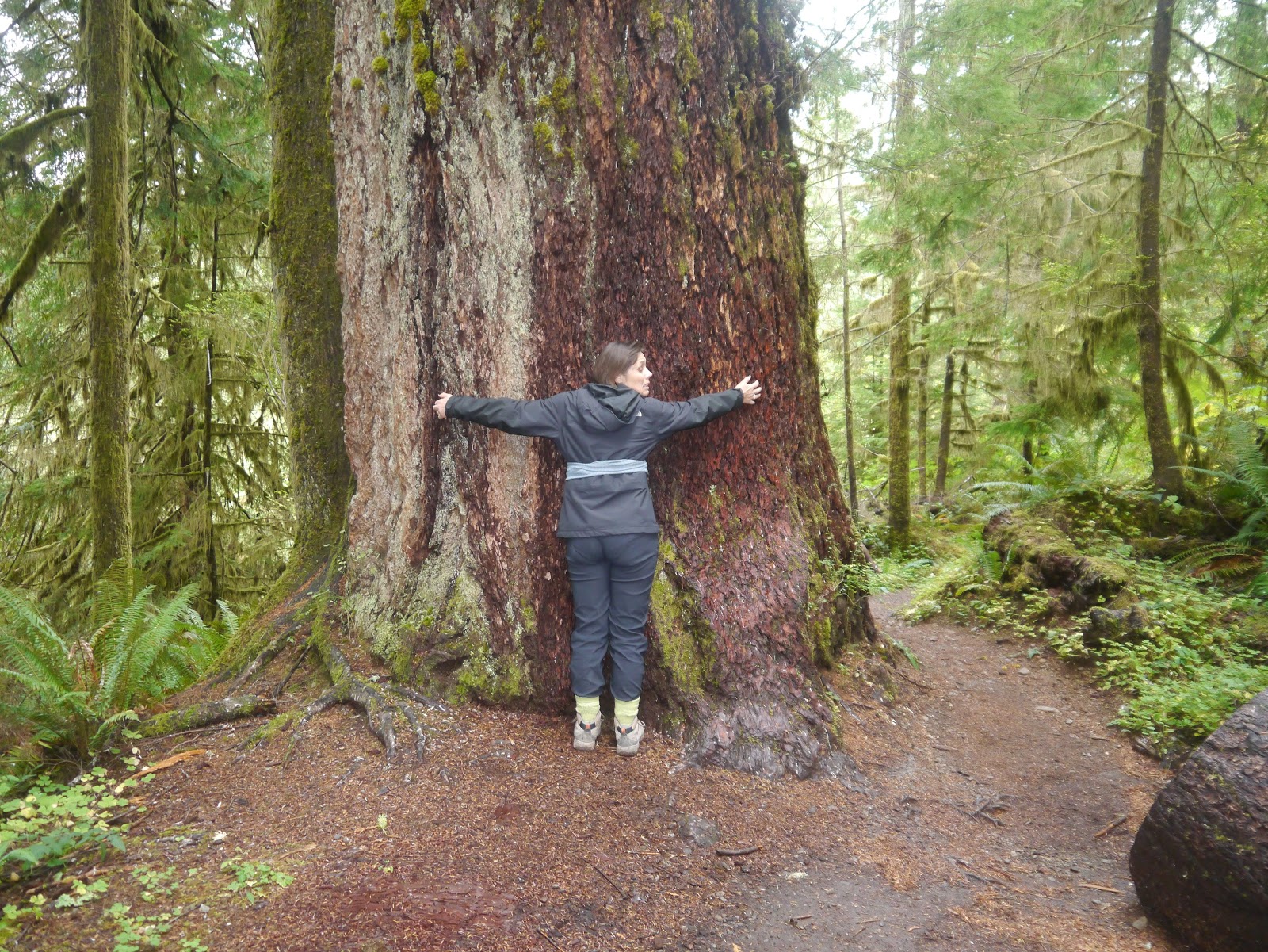
Lake Quinault is a beautiful lake situated in the Quinault Valley. It was formed by glacial action and a natural dam caused by the depositing of a terminal moraine at its western end. It is surrounded by part of the only sizable temperate rain forest in the Northern Hemisphere. The area was home to Native American peoples who lived in an area, which had abundant resources and a mild climate. Trees grow well here and as a result the area hosts some of the tallest trees in the world (of 6 native species).  We followed a trail, which took us deep into the forest, with giant tress towering above us. Rain forests are dynamic echo-systems and the forest floor is filled with the carcases of giant tress, which have fallen as a result of age, wind or flooding. The most damaging are the occasional hurricane strength storms that batter the area. The last great storm was in 2007, which left millions of great trees uprooted. The disappearance of a great tree in the canopy allows new trees to grow, while animals, insects and fungi ensure that the tree’s resources are returned to the perpetual cycle of nature. Just counting some of the rings on these fallen trees shows that many were well over 400 years old.

Towering giants

These are big trees!

Refreshed by our walk and some tea we moved on to Aberdeen. This is traditional logging country but it has seen a recent collapse in the industry, leaving the area poor with significant deprivation. One of the largest paper mills in the area closed in 2009. The area provides a stark contrast with the lush beauty of the Olympic National Park. Aberdeen was home to Nirvana lead Kurt Cobain who died in 1994 at the age of 27 (the same age of other rock legends such as Jimi Hendrix, Janis Joplin and Amy Winehouse) Kurt Cobain was a spokesman for his generation and his premature death by suicide left countless fans bereft. He once said “The finest day I ever had was when tomorrow never came”


Kurt Cobain 1967-94

The last part of the journey through Washington and down into Oragon was one of the most beautiful and sublime car journeys that I undertaken for many years. The road hugs the sea as it winds down the coast. We motored past mud flats with large numbers of wading birds, set against a magnificent sunset, made even more unforgettable by a fuel gauge on zero and no sign of a fuel station!

Wading birds at sunset

 Farewell to Washington


Wednesday, 17 October 2012

Having Fun on Route 101


The Waterfront at Seattle

The Journey starts on 101

I can think of no finer way to leave a city than the ferry from Seattle across Puget Sound to Bainbridge Island. None of the usual terror of negotiating an American urban freeway system, just a short drive to the terminal and a mini-cruise to boot! The Seattle rain held off and the sun shone as the city disappeared into the mist. 

Almost "Ferry Cross the Mersey"

The ferry takes you onto quiet roads more reminiscent of New England; beautiful fall colours and a relaxed pace of life. The parallels with New England were even more apparent when we visited the small town of Port Gamble. Saltbox houses line the small main street leading down to the deserted harbour. The town’s past prosperity came from the lumber trade and the now abandoned ferry terminal. The magnificent general store has been turned into a restaurant and gift shop. What must have been a three story “emporium of everything” has lost its soul and its purpose. A reflection of the fate of this sad but attractive little town.

The main street of Port Gamble with the general store on left

The old physicians house at Port Gamble: Shades of New England

The guidebooks identify Port Townsend as the start of Route 101 despite the fact that the road starts way down the state. This is one of the oldest towns in Washington. Its prosperity is reflected in magnificent commercial architecture and fine Victorian villas up on the hill overlooking the main street.  The railways sadly focused on Seattle and the town’s importance dwindled. Jack London spent a night in jail here on his way to the Klondike Goldfields in 1897. He reputedly got into a brawl when he changed steamers. The town has obviously seen a revival, with galleries, restaurants, B&Bs and gift shops. A clear contrast from the depressing empty high streets at home in recession hit UK.

Jack London

One of the grand buildings of Port Townsend

The star attraction for us was an Ice Cream Parlour called “Nifty Fifties”. The shop is not original but everything in it is and the owner has collected items from across the US. Its like walking back 60 years into an “American Graffiti”  fantasy, complete with a great selection of records on the juke box. I don’t know how the other customers tolerated our rendition of songs such as “Crazy” to the dulcet tones of Patsy Cline, but we had a great time, topped off by Liz’s ice cream soda.
The highlight of the visit was undoubtedly the cashier at the Bank of America who thought that Martin’s Yorkshire accent was sexy. We were delighted for him but at the same time somewhat perplexed.


The "Nifty Fifties" Ice Cream Parlour

A great selection on the Juke Box

Cream Soda at the parlour

Port Angeles looked rather grim and industrial, so we drove into the heart of the Olympic National Park on 101.  The park covers over a million square miles and has a diverse and unique flora and fauna. It was the threat to this magnificent landscape from logging and human encroachment that led conservationists to persuade Teddy Roosevelt to declare in a National park in 1938. The great man visited the Park and stayed at Crescent Lake Lodge where we spent the night in one of the cabins overlooking this beautiful lake. This is a great setting and the Lodge and cabins have a unique position. One can describe the accommodation as quaint rather than luxurious. The last make over must have been many decades ago. Americans tend to be more critical of accommodation than we do and I am surprised that it has survived as it is. It seems to have been living off the Roosevelt legacy for too long!

Lake Crescent Lodge

Lake Crescent 

The surrounding mountains are majestic, often lost in the clouds. The moist atmosphere has led to a wonderful temperate rainforest with gigantic ancient trees set in a primeval forest, with lichen and moss giving the lower branches a ghostly appearance. Thank goodness that the logging was stopped soon enough to save them.

The ghostly Rain Forest trees

Shrouded in moss

Off tomorrow to the coast and our first view of the Pacific Ocean which will be our close companion for the rest of our trip.