Saturday, 10 April 2010

At the Crossroads


The Crossroad where Robert Johnson sold his soul in Clarksdale

Last night I recommended Morgan Freeman’s club, Ground Zero. It is a great place but our appreciation of the blues was notched up a number of levels later in that night. We ate at the club and listened to some proficient electric blues for about an hour. Tim was exhausted and went to bed. Hugh and I moved on to an authentic Juke Joint a few blocks away. I can honestly say that it was the most exciting blues night of my life. What the previous band lacked in energy, Robert “Bilbo” Walker made up for it with high-tension buzzing blues. Red’s Blues Club can easily be missed if it wasn’t for the music. The place is falling down with tiles dropping off the ceiling and water leaking when it rains. We just had a ball of a time and poor Tim was awoken by two excited drunken yobs at 2.00 telling him in graphic detail what he missed. The good news is that we have decided to stay another night to see another local blues legend “T Model Ford” at Reds and Hugh and I have hopefully booked Bilbo Walker to come and play at Montgomery Town Hall. Hugh tells me that he could never bring Gill here because of the toilets, as they are quite some feat of medieval plumbing.


Red's Blues Club: an authentic Juke Joint


Robert "Bilbo" Walker at Reds


Bilbo is the handsome one in the middle

Clarksdale is home to 2 excellent Blues Museums that are well worth a visit. Everywhere you go there are hidden memories of the blues. Some are signposted but most are only discovered after talking with those who lived through it all.


Clarksdale's Art Deco Movie House


Sitting outside Ground Zero

The Riverside Inn on 615 Sunflower Inn is just one of these places. Frank Ratliff’s mother bought the Riverside in 1940 and converted it from a Black Hospital to a guesthouse. During its time as a hospital it was renowned as it was here, that the great blues singer Bessie Smith died in 1937. Smith was one of America’s foremost black musical stars at the time. She was injured nearby in a motor accident and brought to the hospital where she died later that night. The room that she died in has been converted to a shrine. Frank (known to all as Rat) who is not in good health has seen the history of modern popular music unfold within his guesthouse. His mother brought up Ike Turner as a young man (He wrote the first rock and roll song “Rocket 88” in the basement), Muddy Waters (a native of Clarksdale) lived there for a while. Howling Wolf, John Lee Hooker, Sam Cooke and many more stayed there on a regular basis and Rat knew them all. Blues aficionados and famous musicians from around the world stay with Rat and his wife and the guesthouse is a sought after place to stay. Rat invited the 3 of us in and spent the next hour telling us his memories and showing artefacts. We saw the rooms that Bessie Smith (not for long), Muddy Waters and others stayed in.

Rat remembers Ike coming back with Tina for the first time and he feels that history has not treated his reputation fairly.

We met a number of people through the day who either played with some of these great names or knew them in other capacities. I fear that memories are disappearing fast and America is not doing enough to defend and preserve its heritage, especially as they have a black president now. There are few blues tourists on this road and one feels that we are part of an unfolding but disappearing story.


The Riverside Hotel with Rat sitting outside

We are off to see T Model Ford this evening. He is in his 80s, Hugh met him today at the Blues and Rock & Roll Museum. On to see Elvis tomorrow in Memphis.

Elvis is alive but now lives in Vagas

1. Robert Bilbo Walker and his amazing Bass player
2. David Dunavent, local DJ playing with Tim


Friday, 9 April 2010

Mississippi John Hurt

Mississippi John Hurt


I am writing this, sitting in a vast bedroom above Morgan Freeman’s Blues Club in Clarksdale, Mississippi. Tim and Hugh are downstairs having a beer and playing blues. Check out the website http://www.groundzerobluesclub.com/

For the uninitiated, it is reputed that Robert Johnson sold his soul to the devil at the junction of Highway 61 and 49 at Clarksdale in exchange for the ability to play the blues with such mastery and skill. Whether he did or not, Johnson revelled in the suspicion of his links with the Lord of Darkness. He certainly played great blues and it was with this in mind that we drove out of Greendale this morning across the Tallahatchie River to little Zion Church to one of the 3 reputed graves of the great master. This was the last site to claim the body of Johnson but probably the most likely as there are witness accounts of his death close by on the Hopson Plantation and his subsequent burial at Zion Church. Everything to do with him is a mystery but we felt honoured to be standing at the side of his grave.


In homage to Robert Johnson, King of the Delta Blues


WABD Radio out of the Delta. Music was blaring out but not a soul to be seen!

My great Blues hero is Mississippi John Hurt, a bluesman/balladeer who’s music gives us a glimce of the music forms that the black musicians were playing at the start of the 20th Century. John Hurt was a country boy who learnt the guitar at the age of 8, recorded in Memphis in the 1930s and was lost to the world until he was discovered again in the 1963. He had been untarnished by what had gone in between and did not even own a guitar. His fresh finger picking style was recorded on 3 albums. His career was short and he died from heart disease 3 years later.

The stores in Valley, where John Hurt would often sit and play on the porch


The boys are off to play!


Playing on the porch of Mississippi John Hurt's shack

We were lost and looking for his grave in Avalon and accidentally stumbled on his museum and old home in Valley. We first met a local farmer called JR Minga who had known John as a neighbour and told us tales about this humble, gentle old man. JR was in to Chuck Berry at the time and hadn’t realised that he was living next to a legend. We then met Art Browning who was instrumental in setting up the Museum and the Mississippi John Hurt Foundation. Art was a great guitarist and has devoted his retirement to mastering John’s songs and promoting his legacy.

Art and the boys sat on the porch of John’s Shack and played in the sunshine. He also took us to his grave and showed us many of the photographs and mementos that he has collected over the years. What an honour to visit the home of the great bluesman and talk with people who knew him. This trip turns out to be one step better everyday. A special thanks to Art for the time that he devoted to us and for his enthusiasm about my hero.

Art Browning, keeper of John Hurt's Legacy


Buried in a peaceful wooded cemetery close to where he went to church and school

We may move on to Memphis tomorrow but there is still a lot to see in the Delta and who knows whom we may meet at the crossroads tomorrow

Thursday, 8 April 2010

Highway 82 West


The landscape has now changed. The flat open lands of the delta have replaced the forests of southern Mississippi. This was the last area to be settled in Mississippi and it is where many of the freed slaves moved to after the Civil war. The wet lands between the Mississippi and Yazoo rivers known as the Delta was subsequently drained to provide some of the most fertile agricultural land in the world. This is the land where cotton was king. It was great to be driving along with the sun shinning, the windows open and Taj Mahal singing Elmore James’ “Dust My Broom” We are in the Delta proper now and Blues landmarks are everywhere.

Some of the Blog followers have asked about our form of transport. I suppose that many of you expect us to be travelling on Harley Davison’s or in an open vintage Cadillac. I hate to disappoint you but we are 21st travellers and we have decided to travel in a fitting style in out hybrid Toyota Prius


The 21st century Cadillac


Our first stop was at Belzoni on 49W. This sad run-down town was the home to Sonny Boy Williamson. Robert Johnson and Elmore James played here often. We visited the old jail where Charley Patton spent some time and wrote about in “High Sheriff Blues”.

Charley Patton's jail in Belzoni


Across to 61North again to Hollandale. All these towns have suffered badly in the recession. Most of the shops are vacant and I can’t see how they will ever be revived again. We looked for Sam Chatmon’s grave. Chatmon was born in 1911 and moved to the town in the 1940s

An original Juke Joint in Hollandale


61 meets the other famous blues road 82 at Leland. The town was known as the “Hell Hole of the Delta” when 10,000 cotton workers would descend on the town at weekends. Local bluesmen included the great Jimmy Reed, Willie Foster, Little Milton and James “Son” Thomas. Johnny and Edgar Winter also come from the town. We visited the Highway 61 Blues Museum. This is a small, poorly resourced museum but well worth visiting. We were fortunate to meet James “Son” Thomas’ bluesman son, Pat Thomas. Pat played for us and before long the boys were jamming with Pat. Watch the video below.


The boys jamming with Pat Thomas (son of James "Son" Thomas)


We moved on to visit Charley Patton’s grave who died in 1934. He was one of the original fathers of Delta Blues. Try and listen to some of his work if you can, especially “High Water Blues”. It was great to leave a pebble on his gravestone.

We moved on to Indianola, the home of BB King to visit the BB King Museum. BB is well known to all you music fans out there and I will just say that it was a museum not to be missed. What a great man and ambassador for Mississippi and the Blues. Just try and imagine what a treat it was.

Charley Patton's grave on the flat delta land


Drove on to Greenwood where we leave from tomorrow to visit the legendary Robert Johnson’s grave.


The boys Jam with Pat Thomas


The flat delta land with Charley Patton on the radio

Wednesday, 7 April 2010

Natchez to Jackson

We felt really young in our motel this morning. The rest of the rooms were taken by a busload of seniors from a Baptist church in South Carolina. I should think that Hugh is half their average age (and certainly signs better)

Our first stop is at the ruins of one of the most spectacular plantation mansions in Mississippi. Windsor was completed in 1861. Building great mansions seems to have a negative effect on your life expectancy and the owner died soon after it was finished. The house survived the war but burnt down in 1890 leaving these haunting columns. This is a magical place buried deep in the forest and surrounded by verdant vegetation.


The evocative ruins of Windsor

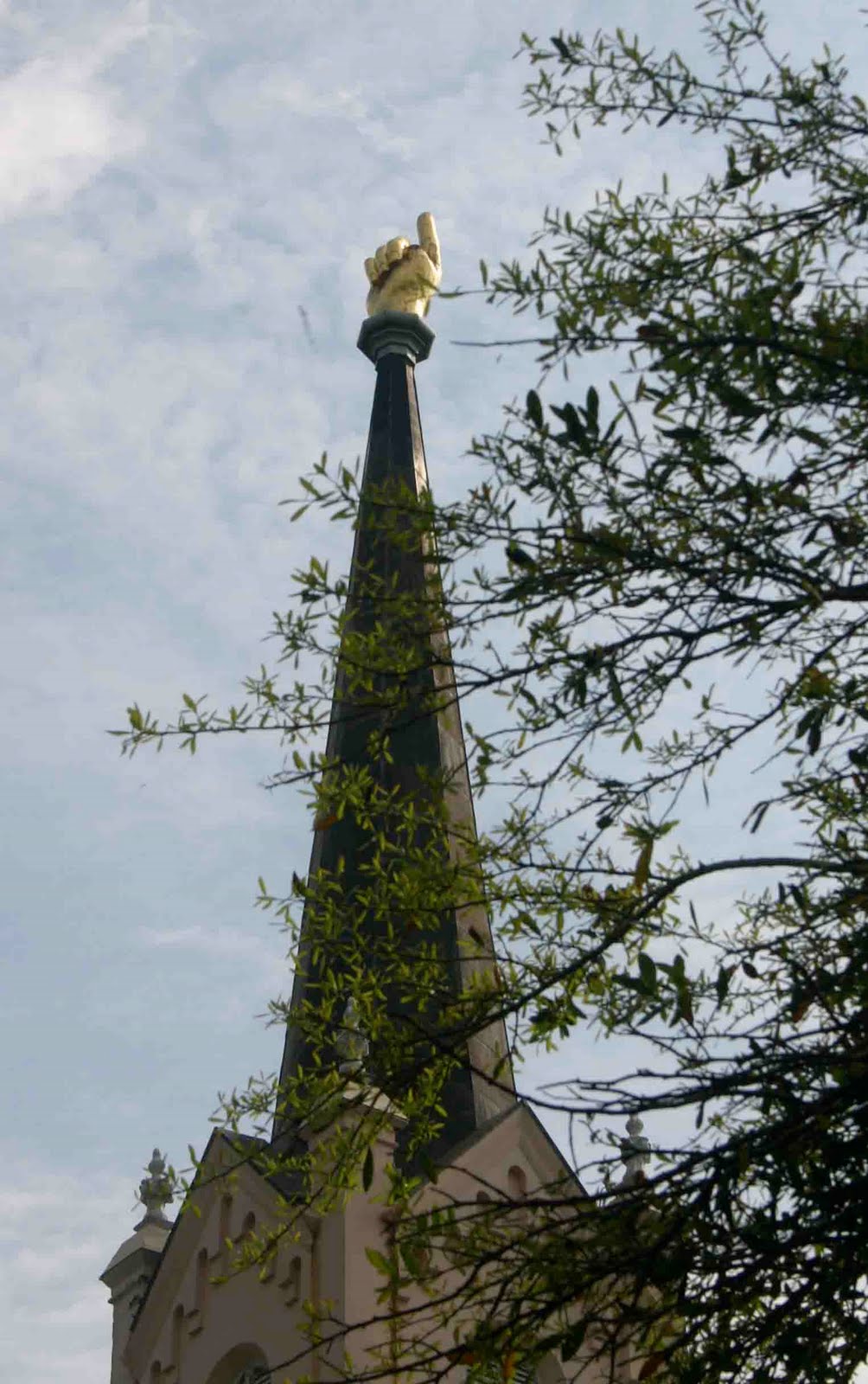
General Ulysses S Grant refused to burn down Port Gibson because it was too beautiful. Many of these small southern towns have suffered from years of deprivation and decline during the 20th century and I am at a loss to understand what the great general saw that was so perfect. I did however like the wacky top to the steeple of the First Presbyterian Church known more appropriately to the locals as the “Church of the Golden Hand.”

The Church of the Golden Hand

Driving across the southern states reminds you of the impact of the churches in this part of America. One passes one church after another on the route, all well maintained and thriving. No wonder that the Christian vote has such an impact on American politics and opinion.

Vicksburg stands on a bluff looking over the Mississippi. Next to Gettysburg this was the scene of one of the most important actions of the Civil War. The Union believed that wining control of the Mississippi would end the war by splitting the Confederacy and severing its main artery. Despite a string of successes, Vicksburg refused to submit. The city eventually capitulated after a ferocious siege that lasted 47 days and cost many thousand lives. We toured the battlefield and many of the monuments. We were blown over by the remains of the Ironclad gunboat Cairo, which was raised from the river Yazoo in the 1960s.

Vicksburg is the birthplace of one of the Blues’ greatest composers, Willie Dixon who was influenced by “Little Brother” Montgomery who moved into the town in the1920s


The Great Willie Dixon

Hugh practicing his Tibetan Throat Singing

The Ironclad "Cairo"

The rescued ship. Still and impressive sight!

All our guidebooks advised us to take a detour and visit the State Capital, Jackson but we were surprised how quiet and uninspiring it was. We eventually found some disappointing live country music, sung out of tune!

Special thanks to a wonderful man called Cotton who runs the bar at Walthall Hotel. He tried to find us a live music venue in the town. Cotton is 83 and tells us that he is thinking of retiring in 17 years time. What a great gentleman.

Jackson is an important town in the history of the blues, despite the fact that it is technically outside the Delta. It was the home of important Blues men such as Skip James, Tommy Johnson and Elmore James. Jackson was a regular stopping off point for many great Blues artists who played in the town and in particularly along Farish Street. It was so sad to see how run-down Farish St had become.


Cotton at the Walthall Hotel

Elvis on the toilet door of Hal and Mals Brewery in Jackson


Tuesday, 6 April 2010

Highway 61 at last!

We left New Orleans on Interstate 10 but shifted over to Highway 61 after 30 miles to start our journey proper. The route to Baton Rouge was more picturesque than the guidebook led us believe. It swung through wetlands on raised roads then over farmland and through verdant woodland. We decided not to turn off 61 to visit Cajun country in Lafayette but drove up through Baton Rouge and on to Natchez (220 miles). Cajun and Zydeco music will have to wait until another time.

Natchez was originally founded by the French and became an important trading port along the Mississippi. The town is built on a bluff and provides a great view over the river. The plantation owners built their mansions here and before the Civil War the town housed half of America’s millionaires. Many faced ruin after the conflict.

We visited one of these great houses called Longwood. The house was built in the shape of an octagon in the 19th century oriental style by Haller Nutt, a very wealthy plantation owner who died of pneumonia during the war aged only 48. His wife was ruined as a result of the war and they were not able to finish this magnificent house. The family lived in the basement until the 1960s but it was never finished. Fourteen similar houses are open to the public. Natchez is a very elegant town.

Longwood built but not finished by Haller Nutt

The Skeleton of the unfinished Octagon at Longwood

We drove down to the old quay where the steamboats tied up and had a cool beer at the Mark Twain Guesthouse and Bar.

The old quay at Natchez-under-the-Hill

A cold beer by the Mississippi

Off to Vicksburg tomorrow and then Jackson (Mississippi's capital and an important place in the history of the Blues)

Memories of New Orleans


Just a few memories from New Orleans to leave with you. We head off today at last along Highway 61 past Baton Rouge to Natchez where the riverboats loaded cotton from the plantations and the owners built their palatial homes. We leave the jazz behind and head for the cradle of Blues and Rock and Roll in the heart of the Delta.

A riverboat moored at the quayside in New Orleans

More jazz on Bourbon St from the Fritzels

Still a home for jazz at the world famous Preservation Hall

One of the great gentlemen on New Orleans

Sophie and her band on Fisherman's

A balcony observer on Royal Street

The architecture of the French Quarter

Classic French Quarter style

Jazz everywhere!

Street entertainment outside the Gumbo Shop

Early morning serenade on the balcony.

Monday, 5 April 2010

Follow your Dreams


The Blues Boys (No Bones, Bones and Throg)

Tim Smit, Chief Executive and co founder of the Eden Project offered 2 pieces of advice, which I think is relevant to us all. Firstly stop trying to get everyone to like you and secondly when you are facing your dying day say “I am glad that I did that” rather than “I wish that I had”! This trip is about chasing at least one of our dreams.

We landed in New Orleans last night and swung into town, found our hotel and were out again by 9.30 to sample the music and the nightlife. Bourbon Street was buzzing. We listening to a blues/rock band and then some traditional New Orleans jazz played by the Shrimp Band. It’s amazing how you can be too tired but some cold beer and good music soon revives you. We eventually get to bed early at 1.00 a.m. after having been up for 24 hours and many thousand miles. Hell, if this is retirement then give me more and if this was a taste of things to come along the Blues Road then give us more.

Bourbon Street at night


Up at 7.30 this morning and down to the riverfront. What a treat to see the slow old river heading down to the sea. After our winter it was good have the sun on our faces with a cool breeze blowing from the water. If this is April, it must get very hot here in the mid summer. The French Quarter lives up to its reputation. Its more beautiful than I expected and it’s difficult to believe that you are in the USA with such a mix of cultures, which in turn influences the architecture, the music and the environment.

As the day progresses, many jazz bands come out onto the street to play and its difficult to find somewhere you don’t hear music playing. There are many styles/genres; Jazz, Cajun, Zydeco, Rock, Gypsy and various fusions between them but new Orleans means Jazz and this what we are in search of. Jacqui and I spend a weekend every year at the famous Brecon Jazz Festival in Mid Wales but there is a certain authenticity about hearing it in New Orleans despite the fact that most of it here follows the traditional (trad) style.

Went to a great music shop in Bourbon St called Skully’s Recordz. The owners were great and very knowledgeable about the local music scene. Look them up if ever you’re in New Orleans.

Well, off for a swim and back into town for some more jazz!